MAIN
MENU MEMOIRS OF INFANTRYMEN
THE
RUSSIAN BATTLEFIELD
MAIN
MENU MEMOIRS OF INFANTRYMEN
THE
RUSSIAN BATTLEFIELD 
|
MAIN
MENU MEMOIRS OF INFANTRYMEN
THE
RUSSIAN BATTLEFIELD |
|
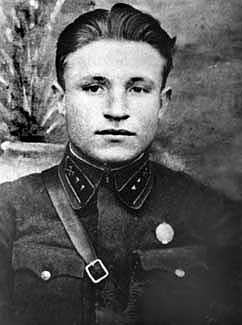
Dmitrii Krutskikh (From D. Krutskikh's archive) |
I was born on November 7th, 1920, in a peasant's family, in the Voronezh (now
Lipetsk) oblast . My father, an NCO of the Tsar's army, during the Civil War
commanded the mounted reconnaissance unit of 1st Cavalry Army's 14th Infantry
Division. Nonetheless, his officer's past affected both his destiny and my own.
In 1931, I finished 4th Grade. In May, my father was arrested and convicted
of, as it was then customarily put, "officer-like gentility." Later,
after two years of imprisonment, he was released. I, until 1934, was in an orphanage.
That year, all sorts of schools began expanding and I was assigned to a vocational
school at a factory. After a year there, I applied to the newly opened college
of political education which was located straight across from our local high
school. At the college, we were trained as commissars (political instructors)
and I was admitted to Komsomol (The Union of Young Communists) - they did not
accept peasants as full members back then and gave one year of probation. In
1937, the country was swept with the call: "Let's Get 300,000 Pilots for
the Country!" The local Komsomol branch decided to send several people,
including myself, to the Leningrad Lenin's Komsomol Pilot School. I wasn't accepted.
I tried to apply to another one, but they wouldn't accept me either. Wherever
I went they would just told me "The admission is over." Now I understand
that somewhere in my application papers, there was a little special stamp, which
I never noticed, that revealed my parentage. The situation was desperate: I
ran out of money and slept in a shed I stumbled upon in the Summer Gardens of
the Mars Fields Park.
All of a sudden, in one of the schools, a colonel, to whom I was speaking, asked
me to come next day to the Mikhailov Castle. I went. I was met by Colonel Zlatogorski
and, after a conversation, I was enlisted in the Zhdanov Military-Engineering
School. We were taught very well. While at the school, I was made a candidate
member of the Party and assigned an acting platoon commander.
It must be said that 1937 through 1939 were the years of mass persecutions of
the officers corps, when a disheartening eradication of military commanders
was taking place. There was not a single lieutenant in the entire school! They
had to pick platoon commanders from among us, ignoramuses!
Thus I graduated from the school. We had a commencement ceremony; the next morning
there was an official meeting. We got together. I was sitting in the second
row. An engineer, 2nd class, comes out in the front and begins telling us about
new weapons. On the table behind him, we see two huge covers. He told us about
the new tanks, airplanes, other things…. At the end, he says: "And
we also have this….. " and takes out an SVT rifle. It is such and
such and such. He turned it around in his hands and put it back in the sheath.
Next, he pulls out a PPD submachine gun from underneath the other cover. Turned
it around, said a little and put it back. Thus, our introduction to the new
weaponry was finished.
I was given the rank of Lieutenant and sent as a platoon commander to the Rybachi
Peninsula. There were only eight of us, Party candidates, among the 200 graduates
and we all were promised assignments in the Far East. It was so popular then!
We had just gone through Khasan and Khalkin-Gol! But those seven went there
without me. I was very upset. I didn't understand it then - it was all because
of my father. Anyway, thanks to the efforts of the battalion commander who spoke
about me with school commander Vorobiev, my assignment was changed and I went
to Kandalaksha instead. At the very least, it was a town. I arrived to Kandalaksha
on September 9th, 1939 and was immediately assigned a platoon commander of 16th
Special Engineers Battalion, 54th Rifle Division. At the time, the situation
was already very tense there. I, of course, did not understand anything but
everybody was talking about war. We began training. That's where I showed off
on skis -- I was a good cross-country skier.
On the 5th of November we turned in all of our equipment and, as if in a drill,
were put on a train and shipped down south. Instead of training camps, we arrived
to Station Kochkana, in the vicinity of Belomorsk. From there, on skis, we advanced
to the border, toward Reboly. We skied for about 40 kilometers. On the way,
we learned how to deploy, take positions, organize reconnaissance. Later, trucks
arrived. We loaded and continued on to Reboly. That's where we waited for the
war to begin. In the meantime, we were getting to know the border guards. They
organized meetings for us, told us about the specifics of the local terrain.
We didn't know anything about the Finnish arms, Finnish mines, never saw any
Finnish clothing. I, and many others, had always thought about the borderline
as a huge, sky-high wooden fence. I was taught a great deal by the "elderlies"
of my platoon - Andrei Khlushchin, Pavel Rachev, Melnikov, Remshu, Mikkonen.
They were 40-45 years old and called me "sonny."
About two days before the offensive, we were ordered to assemble recon groups
to be made of skiers. I selected 42 men who could ski. Those were primarily
Karelians, Finns, Veps, Siberian hunters. As a commander of this unit, I fought
through the Finnish War.
So, when at 6:00 on the 30th of November, I approached the borderline near Post
661, I was asking the border guards who led us to the first farmstead:
- Hey, where's the fence?
- What are you talking about? There's this trail here and that's it.
The first farm was taken easily. We proceeded further. Then took the second
farm. While taking the third farm, we surrounded them and beat the hell out
of them! In that battle, I was shooting from the kneeling position, near a tree.
A projectile hit right in the pointed top of my helmet. I was pushed with such
force that I fell on the ground. So, there I am, lying and thinking: "What's
going on? I am lying here, my soldiers see me lying?" It was thought then
that the commander must be running headfirst in a frontal assault, yelling:
"Hurra! Forward!" and so on and so forth.
With combat, we were moving forward and I must say that we could go as far as
Kuhmo but we were ordered to halt and take defense positions. That's how we
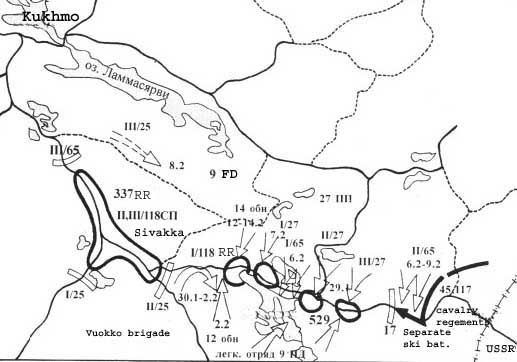
got surrounded. The division found itself in two pockets: 337 Regiment and our
16th Engineers Battalion - within the first ring; two rifle regiments, artillery
regiment, tank battalion, reconnaissance battalion and HQs - in the second ring,
- in a mere 9 kilometres from us. The 5th Border Guards Regiment blocked the
gaps between our positions with two blockhouses. They, however, were subsequently
wiped out by the Finns.
|
Map of 54th RD actions 29.01 - 6.02. 1940 |
We advanced. We had to deploy so that our positions at least could not be cross-fired
by the enemy's machine guns. I, a green lieutenant, couldn't understand that
but our battalion commander Kurkin was an experienced officer. That was how
he put it: "A machine gun here, a machine gun there - lest we be cross-fired."
We spread the companies and dug three rows of trenches. The trenches were covered
three layers of logs. We made dugouts for ourselves and covered them with three
layers of logs, too. Then we laid up minefields and set up barbed wire obstacles.
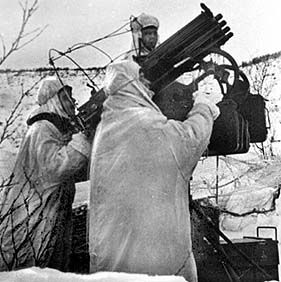
We had two anti-aircraft quad-guns. The Finns didn't have any air force - throughout
the whole war we saw their planes flying above only three times. These quad-guns
got installed in trenches in front of wide-open spaces. Those guns just cut
the infantry to hell! After several attempts, the Finns forgot how to walk in
an open space - they only moved in the woods. We established a good communication
link with Major Churilov's 337th Rifle Regiment. In short, we set up our defenses
in the most proper way! And that's why we managed to hold.. An important part,
of course, was a good rapport with the border guards who knew both the land
and the Finns well. We were fortunate when Colonel Dolin's Ski Brigade came
to our help. They were used very cleverly - they held the road and took care
of retrieving the wounded and ammunition supplies. At that time, however, nobody
could get through to us. Food and ammunitions were dropped from the planes.
Only once four trucks with food and two regimental guns succeeded in breaking
through to us.
 |
Those were heavy, difficult fights. The infantry did not have skis. So, the
troops could move only by road. Until mid-January, we were fighting with pain!
Everything was to be learned in combat. Learning in combat means losing people.
It must be said - our experience was earned through a lot of blood. Only in
my unit, I practically had to replace everybody. There were only Murzich, Mikkonen,
Remsha, Khluchin, Pelekh, Diki and one other guy left, that's it. I had 18 people
killed in my unit.
We didn't know Finnish landmines - we would stumble upon one of them and study
it, until somebody gets blown to pieces. Sometimes we were just lucky. The Finns
used English-made anti-personnel mines, the ones they later started making themselves.
Besides, they also put artillery projectiles right into field obstacles. Fields
in front of wire obstacles were also densely mined, they put mines right into
snow, set up booby-traps. The mining density was very high. Doors in villages
were also booby-trapped. At first, our scouts were getting blown up. But, come
January, we began fighting differently. In late January, we had a second unit
formed in our battalion. We also acquired some kind of sense for these mines.
When you look at the snow at first, you see only an even surface, but after
a while you discern little bumps. You look in your binoculars, then send in
the scouts - indeed, landmines are there.
- A. D. How often did you on reconnaissance missions?
We went every night. The objective number one was to capture "a tongue."
The thing was that the Finns removed all civilians from the battle zone. During
the whole time, we met resistance only at one of the hamlets where a man and
a young woman opened rifle fire. We surrounded the house and, via an interpreter,
offered to surrender, otherwise, we said the house would be burned down. They
did surrender. We brought them back. I was later told that the girl turned out
to be a member of the Lotta organization and was executed.
We walked into a house in one settlement and saw Lenin's portrait on the wall.
Well, we thought, a communist lived here! Later somebody explained to me that
Lenin was held in respect for the liberation of Finland [from the Russian empire],
of which I did not know. We checked out the cellar - there was meat, liqueur,
vegetables. Typically, the cellars were full of stuff in any Finnish house but
we weren't allowed to take anything. I could take some potatoes but it was forbidden,
too. Our rations were pretty meager -- four men were issued a biscuit and a
piece of horse meat per day. We had not seen a bath in four months! There was
no water at our positions. There was only a small brook in no-man's land where
the both sides drew water. But when the political officers found out, we started
pounding on each other. We melted and boiled snow but there must have been something
wrong with the snow water - we suffered stomach pains and diarrhea. We were
also lice-ridden. We would shake our clothes over red-hot stoves to get rid
of the lice. Later, they dropped us underwear that had been treated with Soap
K. After some scanty bathing, we put them on and felt as if our bodies were
put on fire! This underwear had to be washed all over and only then worn.
- A. D. You must have walked a lot back there.
Well, we did walk a plenty. I think, I must have done at least 300 kilometres
during the Finnish War. That would be a very modest estimate. When 44th Division
was crushed by the Finns, some of the troops tried to break through, toward
the 337th Regiment. I was sent to meet them. When I arrived, I met only several
soldiers - the rest had been cut off and slaughtered.
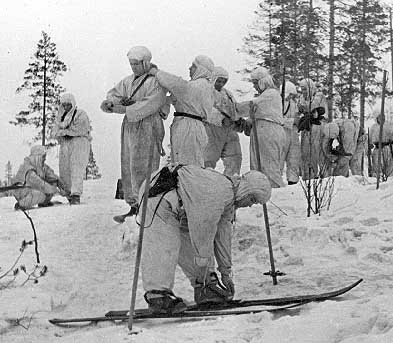
Let's compare, for instance, our skis and the Finnish ones. Our skis didn't
have "peksas" - sewn-on toe pockets but had to be tied up with straps.
To dismount the skis, one had to untie the straps, to mount - tie them up. Too
much hassle. When airplanes dropped valenkis [felt boots] for us, we sewed balls
on and slid the foot straight under the arch.
- A. D. How were you dressed?
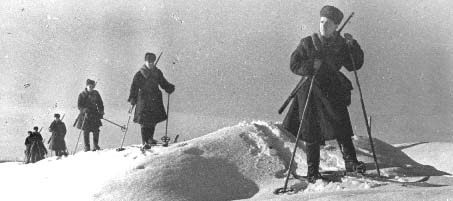
Our outfits were - greatcoats, budenovka [a helmet-like, cone-shaped canvas cap), leather boots. Lots of weight! Then you have your knapsack, mapholder, revolver, rifle, gas-mask. Why did we carry all that? And it was really, really cold! Both we and the Finns burned bonfires openly - it was much too cold. We got winter camouflage and valenki (felt boots) only when the division was already surrounded near Kuhmoniemi. Our airplanes also dropped winter outfits - black short sheepskin coats for commanding officers. How were we expected to run in attack in the snow, in a black sheepskin coat? Especially, when the battalion commander is leading the attack, 25 metres behind him - the company commander, then - platoon commanders. Of course, the Finns picked out the officers first!
- A. D. What did you think about Finnish soldiers?
Finns make very good fighters and the Great Patriotic War they fought better than the Germans. I see several reasons for that. First, they knew their land and were prepared for this climate. This resulted in minute differences in camouflage, tactics, reconnaissance, all of which eventually bore fruit. Firearms training - excellent. In combat , they are also solid. I noticed, however, that, when they attacked our defense lines, they would make a brisk run for 100-150 metres but then lie down. The Finns are more talkative than even the Germans. The Finnish artillery didn't work that well, but their mortars were good.
- A. D. Were you wounded?
 |
I was wounded twice during the Finnish war. The first one was bad. A shell exploded in tree branches and a shrapnel hit me in the left side. We were already running short on medical supplies but we had a great doctor - Captain Sitnikov, who was just saving us. I spent 11 days in the dugout but then again began going out on missions. My light would I got this way. We had a wickerwork strung across a clearing in the woods lest their snipers see our movements. Their mortars were working. I had to go through our pickets and check out the path from our sentry posts to the Finnish lines and beyond. I took two soldiers and took off. Right this minute, the Finns started a mortar bombardment and a projectile hit me in the left hand.
- A. D. What kind of relations did you have with commanding officers? With your subordinates?
We were just friends with my subordinates. There were people of many nations, we lived close and merrily. But we didn't have any relations expressly proscribed by the Service Regulations. The soldiers took care of me. Everything was in the open. Any rowdiness by an officer would end up by his death in the first combat. I have no doubt about that. As far as our command, we had a good relationship with our battalion commander. This was the guy who led us in combat, along with his staff commander and commissar [senior political officer]. We also had good rapport with the regimental officers. On several occasions, I reported to Division Commander Gusevsky, Division Staff Commander Orlyansky, Intelligence Commander Nikiforovich. They paid attention to what I had to say, never interrupted me during the report. I do think that General Gusevsky was a talented officer. Once I reported to Mekhlis who came to Saunoyarvi, the Division headquarters, and spent a night there. Mekhlis left a bad impression on me. He, a very rude person, threatened to execute me if I didn't bring him a prisoner next morning. We spent the whole night on our stomachs - crawling across the lines, the Finns never left their pillboxes. On my return, I reported to the Division Commander and mentioned "That's it, they're going to execute me now." Gusevsky said "Don't worry, he'll come out when you are out there tomorrow you will get him. Don't take unnecessary risks." He reported to Mekhlis and I wasn't called in again.
- A. D. What weapons did you carry?
- I had a rifle and a Nagant revolver.
- A. D. What can you say about the Suomi submachine gun?
- We were on a recon mission once. Our lookout is signaling and I go to him.
- Commander, look, there's something shiny in the snow.
- Everyone pull back! Get me a long stick! - I issue a command.
 |
I am thinking, if it goes off - I will die alone. I am pushing it with the stick… It was a cartridge for a Suomi machine carbine. The gun wasn't there. The battalion commander got together all the technical people and Captain Murashkin, Deputy Commander, spent all night treeing to figure out how to load it. He did figure it out and showed us too. We got hold of a Suomi when we took Khiliki 3rd. But we had a very strict order - not to take anything off the dead. Everything had to be turned in! However, when we took defense, then we used them. I fired a Suomi myself. It's a good gun but very heavy. It hangs on your neck like a log. Anyway, the submachine gun's strength is in its impact on the enemy's morale.
-- A. D. So you couldn't pick anything foreign?
Yes. I downed a captain under the barbed wire obstacle. We then counterattacked.
On the way back, we took his camouflage coveralls off and there we saw a fox
furcoat. We took the furcoat off, too. That was when I saw a "Pavel Bure"
watch on his wrist. I took it to the battalion commander. None of us had watches
back then. The commander slammed at me:
- What did you bring this for?! Now, what if the special department shows up
and begins questioning you? Who's gonna do recon? Take everything away!
- They've started cutting the furcoat, - I said.
- What for?
- Soldiers want to sew stockings.
- Okay, let them.
I gave that watch to a sniper. He took them home but the Kem's NKVD (Commissariate
of Internal Affairs) took it from him. They were prohibited.
For instance, the Finns had great alcohol-filled compasses. The ones we had
- you put it down on something, the needle is still moving. Not with theirs
- once it stopped, it stopped. In the nighttime, their entire compass is lit,
ours only had a glowing dot on the tip of the needle.
The Finns also had those little sleds (ahkios) which could carry a machine gun,
ammunition or the wounded. There were light, lined with thin metal sheets underneath.
These sleds glided in the snow like on water! The ahkio had two straps - a long
one and a shorter one - to be pulled by two men. We did not have anything like
that. Say, somebody gets wounded on a recon mission (and I did have such misfortunes),
how carry him back twenty-thirty kilometres in that terrain? Impossible! We
make a hundred metres - everybody can barely breathe! Of course, we tried to
make some sort of stretchers. But was it ever hard to carry people on them!
When we took Finnish ahkios - we weren't allowed to use them. Later on, we began
building our own, with wooden box planks, but ours were triangular, with sidings
on the edges.
- A. D. Did the Finns have cuckoos (snipers)?
They did. Don't trust anyone who says they didn't - it would be the same as to say that we had submachine guns. I myself took a cuckoo off at 600 metres. And they're lying when saying those were observers, not snipers. They were a real menace for us. We also had snipers - Rochev, Maksimov, Pelekh.
- A. D. Did you have mortars?
 |
We didn't have them. Only in the Regiment I saw a 50-mm unit. I think they
were useless in the woods.
When, on March 12, the truce came into effect, we received an order to refrain
from fire. Only if the Finns attack us. Deputy Battalion Commander Voznesensky
was dispatched for negotiations. How to outfit him - all the clothes we had
were worn out, torn, burned ! The whole battalion was dressing him up. And we
barely managed to outfit him more or less suitably. There were three rounds
of negotiations and I was present at the second one. We weren't supposed to
take any weapons but I did have a Nagant revolved hidden under my arm. There
were three of us and we were met by three Finns. We carried white flags. It
was frightening. We stopped. Only 5 metres between us. We began talking through
an interpreter. We said that the war is over, a peace agreement signed, we were
very happy - it was our victory. There should be no provocations and shooting.
We were going to celebrate - play accordions, sing and burn bonfires. The Finns
confirmed that the peace agreement was signed and there should be no provocations.
In the end, they said "Please do sample our treats." They took off
some kind of a cloak of the tray one of the was holding all along and we saw
there was sliced fish, meat, I think, pickles and a flask - in which, it turned
out, was some sort of berry liqueur. I didn't drink but Voznesensky drank a
glass with the Finns. On the first and third rounds I wasn't present but remember
they exchanged with knapsacks. In ours, we put some canned food, "Voenny
Pokhod" biscuits, and vodka.
When we were leaving, we were ordered to blow up all of our fortifications and
fill up the trenches. The Finns were ordered to come off the road for a hundred
metres. We sang songs, played accordions. They played harmonicas. I saw them
wave hands at us, shake their fists, and we did respond in kind.
As we had been surrounded, I wasn't decorated. They gave me only the "Excellent
Serviceman of the RKKA (Red Army)." It was held in respect, though.
What can I say about the Finnish War? Politically - it was a defeat, militarily
- a disaster. The Finnish War had a deep impact on us. We saw a lot of grief.
We suffered huge losses - which do not even closely compare with theirs. Our
dead were left to lie in the foreign land.
|
|