MAIN
MENU MEMOIRS OF INFANTRYMEN
THE
RUSSIAN BATTLEFIELD
MAIN
MENU MEMOIRS OF INFANTRYMEN
THE
RUSSIAN BATTLEFIELD 
|
MAIN
MENU MEMOIRS OF INFANTRYMEN
THE
RUSSIAN BATTLEFIELD |
 Aleksandr Vasilevich Bondar'. Ulianovsk school 1940 |
I am almost 80 years old. I am of Ukrainian nationality, born in the Right Bank Ukraine [Western bank of the Dnieper River, which virtually bisects Ukraine] in the Vinnitsa region. In 1940, I finished 10th grade and in the same year I entered the Ulyanovsk Tank School. Why did I become a tanker? I have to say that during the years when I was studying in school, everything was geared towards preparing the population's morale for the inevitable war with fascist Germany. So I saw myself as a future fighter. Besides that, my uncle was a military man, and in '39 he told me, "Sasha, you will finish high school. I advise you to go to a military college. We cannot avoid war, so it's much better to be a commander in the war - you can do more because you will be better educated." These words played a part in the making of my decision, and I enrolled in one of the best schools - the Ulianovsk Tank School. But, I didn't complete the whole course - one is supposed to study for two years and I studied one and a half.
- A.D. Was the training at school geared towards preparing you to be a tank commander?
Not a tank commander, it was geared toward the training of tank troop lieutenants, and a lieutenant could already become commander of a tank, platoon, or in the best case, a company commander. Not more. You could say that they prepared us to be commanders of light tank platoons. When, in Leningrad in '39 the heavy tank KV (Klim Voroshilov) came out, then they started to place not sergeants, but lieutenants as tank commanders. That's why I was a heavy tank commander in the Battle of Moscow. And after, I was already a platoon commander. The highest post I reached during the war was a tank company commander.
- A.D. What was in the school's program? What were the practice machines - T-26, BT-5?
I report: The course consisted of three companies of 100 cadets; in each company were four classes with 25 people. Thus, 600 people studied simultaneously in two courses. Every year the school had 300 graduates. The school was provided with a special battalion; it had all the machines that we studied. This battalion was located in camps twenty kilometers from the Volga. We went there in the winter and summer. We drove and fired the tanks, serviced and repaired them, and so on. We studied both the T-26 and BT-5. Generally, the school prepared lieutenants for BT tanks. These were very popular tanks at the time.
- A.D. Were you trained to drive on wheels?
Yes, of course. It was very awkward because a steering wheel had to be specially installed. A drive shaft went from the gearbox to the rear supporting wheels (it had four supporting wheels), a special "guitar" had been set for a transmission of revolving motion not to the driving wheels, which drove a caterpillar track, but to the rear supporting wheels, but they were enormous and the steering wheel was very difficult to hold because of that. The tank could go up to 90 km/h, but the strongest man could drive at that speed for only 20-30 kilometers, not more, otherwise he wouldn't be able to hold on to the steering wheel. The movement on wheels was only intended for driving on asphalt or a paved road, so much so that the ability of the tank to travel cross-country on these wheels was rotten.
- A.D. Did you fire a 45 mm gun?
Of course.
- A.D. At what kind of target? Moving or stationary?
Both stationary and moving. We performed various exercises. "Firing in defense" - this is when a tank had been dug in, distance was checked, a reference point supplied, in order to have good target lines, the tank itself was concealed. Then the target appearing in the area of the reference point is struck with the first shot.
In an offensive, firing is conducted both during short stops and on the move. When you are firing from a "short", the commander orders the driver, "Short." The driver stops the tank, and the commander counts to himself, "twenty-one, twenty-two, twenty-three." At that time he should be able to aim the gun at the target, determine the speed of the target, if it's moving, make a correction in the gun's sight and make the shot. If you stay more than 3-4 seconds in one spot - you will be hit by the enemy yourself. Firing on the move is not very effective and is usually aimed in the general vicinity of the target.
- A.D. How much practice was there on the machines?
Practice was sufficient in order to know how to use a BT. We studied the materiel in great detail. The M-17 engine is very complicated, but we knew it down to the last screw. The gun, machine gun - we took them all apart and put them back together, the tank was easily understood by the crew. Today it is not really that necessary for a crew to study the tank. A tank is very precise and smooth, the only thing left for the crew to do is press the buttons. Today the crew does nothing. If the tank got knocked out - there is nothing left to say.
- A.D. Driving, firing, commandeering, command and control - what was given more attention?
Two issues - firing and driving.
- A.D. Did you have any T-34 and KV tanks at the school?
They arrived at the school. The KV and T-34 came, but we had to master them in the course of war. Three KV tanks were unloaded in Ulianovsk itself, in the Lenin Square above the Volga. They let us get inside the heavy tank and drive it to the Lenin monument, put it in reverse gear and drive back, to go one more time to the Lenin monument, but to switch from first gear to second and come back. Van'ka gets out, Mishka gets in. With this experience I received my own KV and left for the 20th Brigade at the Borodino field. The war taught me the rest …
- A.D. How did the war start for you?
The war found me in school, in camp. The school chief, former brigade commander in the Finnish war, without a leg, came out onto the rostrum and said, "My boys, the war has begun. It is going to be very big and very long. Study and don't make me send you out prematurely. Study as much as possible. When it's necessary, we'll send for you. Don't worry, everybody will get enough of war."
In October of '41, I graduated from the school as a lieutenant and found myself in the city of Vladimir where the 20th Tank Brigade was being formed. I received a KV tank and on 11 October 1941 I was already at the Borodino field as a part of that brigade. At that time in the Borodino Field they had the 18th, 19th, and 20th Tank Brigades and the 32nd Rifle Division under Colonel Polosukhin, which had arrived from the Far East. If it weren't for three of these tank brigades and Polosukhin's rifle division, the Germans would have come freely to Naro-Fominsk because after the encirclement of our troops near Viazma, all the roads to Moscow were left open. The Germans pressed north toward Klin, and south toward Tula, they made the most enormous mistake, because the eastern direction was open to them.
- A.D. Was the brigade at full strength when it went into battle at Moscow?
The brigade went into the Moscow battle with very different tanks: I think there were no more than 7 KV tanks, no more than 20 T-34s, and the rest were T-60s, BTs and T-26s. So the brigade was fairly weak. Virtually, it had been assembled from everything that could have come together from the nearest directions. We were formed in one week: the formation began on the first, and on the ninth we had already loaded onto flatcars. Marshal Fedorenko arrived, presented a banner, we marched around town, the townspeople applauded us, loaded us up, and sent us on our way to Moscow. Tanks were waiting for us there - in Golitsyno, in Dorokhovo. We arrived, got into our tanks and drove out to the Borodino Field.
- A.D. Tell about your first battle.
The first battle was difficult. Our brigade was deployed on the Borodino Field in the second echelon of Fifth Army under Leliushenko. The 18th and 19th Tank Brigades and the 32nd Rifle Division were stretched out in the first echelon, and we were in the second. But when the enemy broke through in 32nd Division's sector in the very Borodino Field, our brigade was deployed and was dug in the ground. My KV tank only had its turret sticking out with the 76 mm gun, so it was comparatively easy for me. Without any fear, I burned two armored personnel carriers from a distance of 500-600 meters, and when the Germans jumped out of these carriers I kept pouring machine gun fire on them.
"On October 15th, Hitlerites broke through to the Artemkino village. The 20th Tank Brigade arrived in time from the reserve to help infantry and artillery, and destroyed 10 tanks, 15 guns, 1 armored car and 7 enemy machine guns in the first battle. The village remained in our possession." Could you comment on this?
When on the 10th we arrived to the Borodino Field, the brigade commander, Colonel Orlenko, came out to the Old Smolensk Road to decide where to deploy tanks. This was at night. At this time a car with the lights on drove up to us at high speed from the direction of Gzhatsk. He raised his pistol, stopped the car with Red Army soldiers sitting in it, went up to the lieutenant sitting in that car, and said: "How dare you violate the blackout?!" - a shot rang out and the brigade commander fell, the car sped away, no one realized anything, and so it drove off in the direction of Vereya. So that was our first serious defeat. Orlenko's second in command, Antonov, took charge. And about that first battle, I will not philosophize especially… I don't remember if it was this battle or another, I know that my tank and I destroyed two armored personnel carriers with infantry. I don't know what was going on at the flanks there. And then we already started to retreat, to reatreat toward Akulovo.
|
KV-1 in attack. 1944, Karelian front |
I have more impressions of the KV, when we took the counteroffensive. Our brigade
was taking Ruza. We got to the town on January 21st. The city itself was on
a hill on another, on the western bank of the river by the same name, and our
bank was gently sloping. The infantry was pushed to the ground by enemy fire
and wouldn't advance. In all, we had four KV tanks in the brigade, and the rest
were T-26s and BTs. That is to say, I was like a grenadier. These little tanks
didn't play a role, they burned like candles, but the Germans still did not
have the means to burn KV tanks from the front. So, the division commander,
to which the 20th Tank Brigade had been attached, ordered "Send forward
a KV tank to cover the infantry, so that it would come out onto the ice and
attack Ruza." And the battalion commander said,
-"Son, you are going to drive on ice."
-"Well, you do know that the tank weighs 48 tons and it's January 21st,
which means that the ice isn't 40 centimeters thick yet and it won't hold."
I say.
-"Son, make sure you don't drive far, so when you start to sink, you'll
still have time to jump out."
We had to carry out the order, otherwise the infantry wouldn't advance and would
not take Ruza. I said to the driver, Miroshnikov, a former actor from the Voroshilovograd
theatre, who was four years older than me (he never called me "Comrade
Lieutenant," but always: "come on, lieutenant, come on, lieutenant."
I considered this normal because I had only just arrived, and he fought from
the western borders and already had the Order of the Red Banner).
-"Miroshnikov, you just make sure to put the transmission in neutral if
we go to the bottom so that when they pull out the tank, it won't drag out,
but will roll on its caterpillar tracks.
-"I know this, Lieutenant, I know."
And I say to the rest of the crew members,
-"Don't close the upper hatch." If we sink, we could still push it
out and bail out.
And so it happened. We went 7-8 meters and then - the tank sank to the bottom. We had enough strenght in our tank overalls, padded jackets, and felt boots to bail out so the water was up to our necks, because the tank was 2.8 meters tall, and I was 1.65 meters, so it was clear that if it sank, I would've drowned as well. The infantry had already seized the enemy bank, so there was no machine gun fire from that side. Then they stripped us naked right there on the bank and wrapped us each in a sheepskin coat and sent us to the grove, gave us a glass of vodka each, and said, "Sleep!" We slept through the night, and in the morning the commander of the repair brigade woke me up and said, "Bondar', let's go to Moscow for some cable to pull out the tank. They gave us a truck and we went to the place where the Cathedral of Christ the Savior is today. There were small coils of American cable - very light and very durable, we rolled this coil to the truck and by the evening returned to the Ruza again, the sappers hooked up our tank, pulled it out, dried it out, replaced the batteries, and already in three days I was on the offensive again. So now whenever I go to Christ the Savior with my family, I say, "Keep in mind that there, where the Cathedral of Christ the Savior now stands, in '42 I took a coil of American cable there."
- A.D. And have any other battles remained in your memory between the October and January battles?
-The most difficult thing was that we had to retreat because the Germans inserted strong forces in the center region in Borodino Field, and we had to retreat from one defensive line to another toward Vereya. Our brigade crossed the Old Minsk Highway. We were taking casualties. There are now many cemeteries in Vereya and in other populated places, where our men were buried. I was able to escape injury in these defensive battles. But there was nothing special to remember.
- A.D. So they pulled you out and already in 3 days you were back in combat?
-Yes, the main thing was that the driver had proven himself worthy of my trust, and the transmission was shut off. When we got the cable and pulled out the tank with tractors, the engine did not turn, the rollers rotated the tracks, and we pulled it out easily. But most importantly, the driver was able to turn off the engine, if he had not done this, then the engine would've pulled in water instead of air, and it would have received a hydraulic blow in the cylinders, and that would have simply blown it up.
- A.D. And then?
-And then we approached Gzhatsk, which today is called Gagarin. We took up the defense. It was already sometime in April. Our task was to stop the new German counter offensive. At the Supreme Command headquarters, at the western front under Zhukov's command, there was fear that the Germans would not forgive us for when we cut their northern and southern flanks at Kalinin and Tula and drove from them from Naro-Fominsk to Gzhatsk. There was information that they were transporting divisions and brigades from France, and that they felt obliged to justify themselves with a counteroffensive. Knowing how many casualties we suffered on the offensive, they could easily have improved their business and taken Moscow. So, our brigade, other brigades, divisions had been dug in, in the Gzhatsk region, and in Uvarovka they were ready to defend themselves, if the enemy broke through to this region. And so we waited until August, and at the beginning of August, our brigade was transported to the Kalinin front to the Shakovskaia station.
- A.D. You said that you were lightly wounded?
Well, I went out to reconnoiter where to deploy the tank. We went out to the
forward positions of the infantry and I received a bullet wound in my right
arm. They dressed my wound, the brigade was relatively unoccupied, and in a
week I had found myself back in the tank again, that is to say everything was
okay. But the serious wound that I got was already at Rzhev.
Toward the spring of '42, the Western Front advanced at most 250 km. It was
already clear that Moscow had been saved, but Stalin and the headquarters were
afraid of the possibility of a new German offensive against Moscow, and so they
continued to regard this as the main front. And so they fortified and fortified
and fortified this front. But still there was little ammunition, little artillery
and the main thing was that the headquarters did not have any data about what
the Wehrmacht was planning for the summer. Stalin and Zhukov were convinced
that in the summer the Germans would try to seize Moscow again, but the Germans
were not stupid, they understood that since they had failed once, the Russians
would be fortified. The Wehrmacht decided to attack in the south. And then Zhukov,
having agreed with Stalin began the offensive from the line we reached during
the winter counteroffensive, to interdict the Germans from removing their troops
and sending them to Stalingrad.
They transported us to the Kalinin front. We marched 150 km. I was already the
HQ platoon commander in Medvedev's tank battalion. This battalion was equipped
with T-34s. Incidentally, my KV tank was blown up by a mine at a later time,
and I don't know anything about the fate of its crew.
|
Tanks in ambush |
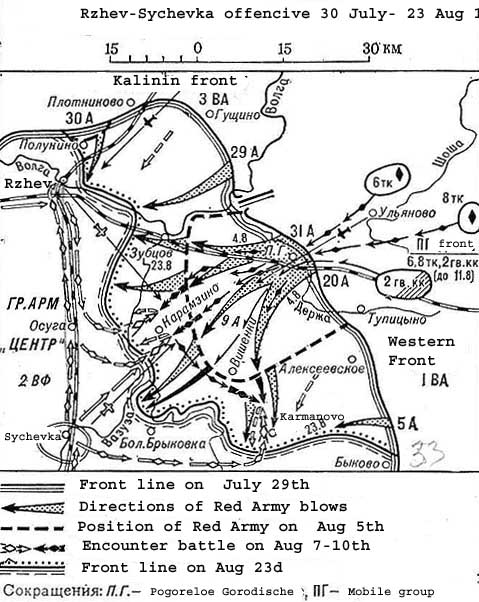
We started the August offensive of '42 from the Shakovskaia station, at Pogoreloe
Gorodishe, toward Rzhev. Zhukov then figured that we would take Rzhev and cut
off the so-called "Rzhev balcony" - a bridgehead for an offensive
on Moscow. It was not successful - the balcony was not taken until '43. We did
not have enough strength to begin a real offensive. I remember the battalion
commander, Medvedev, gathered us, the commanders of companies and platoons and
said, "In this offensive, the Germans must be rolled all the way to Smolensk,
so be certain. Advance. Carry out your tasks," but we did not move very
far ahead. Although there were results for the first five or six days, and we
were able to successfully drive the Germans off somewhere around 70 km. I must
say that it was the first Red Army offensive in the summer, if you don't count
the El'na operation in 1941. And we still did not now how to attack the summer
German. I saw that during the offensive our jumping off positions were 3 km.
from the front lines. Of course this was incorrect, the infantry needed to be
no farther than a kilometer away, not three. Already in the fall, after my wound,
my brigade reached Karmanovo, but what my battalion commander had said, that
the Germans would roll all the way to Smolensk, that didn't happen.
We realized that from that point we would advance on the Germans who had successfully built up their defenses - not stretched out in a single line, but in pockets, in strong points. We learned to build up our defense from them, so at Stalingrad our defense was also in pockets. In the past, the defense for us had been a three kilometer trench, with openings for machine guns, for SMGs. At the beginning of the war we had 150 divisions stretched out in one line from Murmansk to Odessa, and the Germans created three groupings: Center, South, and North, and created a five-fold superiority in these sectors, how could they not with us stretched out in a single line. And so we learned the defense in that Rzhev offensive.
- A.D. Did they reinforce you with tanks after the Moscow battle?
-Yes, of course. T-34s arrived, unfortunately they were Stalingrad T-34s, with
their supporting wheels without rims. They rumbled terribly. I fought in just
such a machine. Many T-60s arrived, manufactured at Gorky. There were still
very few of KVs because Leningrad stopped producing KVs, and Chelyabinsk still
had not started up production, so the KVs were simply assembled from the parts
of damaged ones. There were many T-34s, our battalion had 30 of them, that is
we were a completely T-34 battalion.
There are two episodes from this offensive: The HQ platoon contained the battalion
commander's T-34 and two light tanks - T-60s, so he took one with him and left
one with me. - "You will follow after me. Maintain communication with me
and when I call you, then you come." In a defensive battle there was little
of everything: there was little ammunition and little artillery. When the offensive
began, I saw for the first time what powerful artillery bombardment was. It
was impressive.
We went on the offensive. I was one or one and a half kilometers behind our
combat formation and suddenly saw a field dotted with our dead and wounded soldiers.
Young guys, with Guards badges, in brand new uniforms, in soldiers' shirts…
A German machine gunner sat in a pillbox and wiped out our soldiers. This was
such an inept surmounting of the no-man's-land. The soldiers were ready for
anything, but the commanders did not know how to attack properly. They needed
to bring up the mortars, some artillery, suppress this machine gun, but no,
the commanders urged, "Onward! Onward!" It was a hot day. I remember
that a nurse ran around the field and cried, "Oh, kind people! Help me!
Help me take them away to the shade!" I helped her drag the wounded over.
The majority were in a state of shock, that is to say unconscious, so it was
hard to tell who was wounded and who was already dead. It was a very oppressive
impression…What big losses, how much the war costs us?… From that
point on I never saw such inept command, so that one German machine gun wiped
out an entire clearing of people. These were the problems of the first defensive
period of the war, when we still did not know how to fight properly. But we
learned to fight, like Peter I learned from the Swedes, so we learned to fight
from the Germans right up until Stalingrad. And after Stalingrad we did not
need to learn from them anymore, we could already fight.
I remember I had already gone 15 km with my tank - how much equipment the Germans
had abandoned: supporting vehicles, repair shops. You stop at this vehicle and
there is a white towel for the service of the materiel. I would've taken such
towel to wipe my nose, but they had them all in boxes, they were repairing something
and wiping it with these towels. I thought, "Yeah, you sure live well,
guys!" Then I came out and saw a BMW motorcycle, I had never seen one like
that and I didn't know how to drive a motorcycle at all. When I sat down on
it, I didn't know how to shift gears because I didn't know where the clutch
was. And when I grabbed the handle of the clutch it lurched from its place,
I thought, "Okay, as long as it goes, I'll simply adjust the speed with
the gas." My tank commander was driving in the T-60 tank, and I rode the
motorcycle behind him. I had ridden like that until the evening, before I wound
up in the brigade and the counterintelligence officer said, "You need to
fight, so I'm taking the motorcycle from you."
|
|
And so on the 7th, we wound up near the village of Krivtsy. At that time only three tanks were left in the battalion: two T-34s and one T-60, and all the others had been destroyed. In war there existed such a law: the brigade receives combat orders up until the last tank, if the last tank has been burnt, then the brigade has the right to be excused from battle and to be dispatched to reorganize at the rear when new tanks arrive. I understand this now, but I didn't know it then. The battalion commander summoned me and said, "Son, there is nothing for me to command. You will go fight. There are two T-34s for you - my tank and lieutenant Dolgushin's, my friend from the Ulianovsk school, and a T-60. Try to break into Krivtsy at night and hold there and in the morning the infantry will get there." That was the entire mission. Ahead there was a river and across it a bridge, as a rule the bridge should have been mined by the Germans. And in the stream there was a swamp so that if you drove there you would get stuck, and that means you would not be able to carry out your mission. I decided to take a risk - to "sacrifice" the T-60, because if the T-60 can make it, that means that the bridge isn't mined. But, we made it. The fact that the bridge wasn't mined was to my greatest joy. We entered the little village and they opened machine gun fire on us and we started to fire on them, too. I wanted to fire the cannon, but I had to keep poking my head out, looking at the gun so that it didn't touch the ground and didn't look at the sky since it was already getting dark. I saw Dolgushin's tank catch fire, I thought, "Why aren't you jumping out?! Why aren't you jumping out?!" They I saw - they jumped out, I thought "Thank God!" I wasn't even thinking about myself. I was left with one T-60 and T-34 on the outskirts of the village. In the morning, early morning, because it was still chilly, the Germans came with a counterattack at 6 o'clock or something. I saw for the first and last time how the dense line of Germans advanced, clothed for the night in unbuttoned overcoats with automatic weapons and carbines. I saw their faces - hairy and, one may assume, drunk. I kept mowing them down with my machine gun and shreds of their overcoats flew out from their backs, and then they just fell. It seemed a lot like a firing squad execution… I managed. I had held out. I had wrecked five dug-in tanks. There was nothing they could do because those were Pz.III, Pz.IV tanks, and I was in a T-34 whose frontal armor they couldn't penetrate.
- A.D. But did they hit you?
Yes, of course they did.
After midday a knock resounded at the bottom of the tank and a soldier said,
"Lieutenant Bondar'. A note for you from the battalion commander."
I say, "Take it through the hatch." The commander writes, "Son,
at five o'clock in the evening 'Katyushas' will play. As soon as they play,
try to break through with the infantry to the opposite end of Krivtsy."
That was the whole order. Everything was clear: there were no separation lines
from neighboring detachments, no reference points, simply: "Son, try to
break through to the other end." And so I gave orders to get ready.
And so off we dashed. I see a clearing bathed in sunlight on the other end,
and I have only one wish - to get to that clearing, if it's not defended, that
would mean the village is mine, and I wouldn't advance further -- I will have
carried out my mission and stayed alive. As soon as I thought that, I see through
the periscope - a German tank gun! A missile to the side! The driver cries,
"Commander! They killed radio operator Tarasov!" I bend over Tarasov
- he is all black, the projectile went right through him. Another blow! The
tank stalled and caught fire! We had to save ourselves because the tank was
burning. I threw back the hatch and yelled to the crew, "Out of the vehicle!"
and jumped. All three jumped, and the dead remained in the tank.
We jumped onto a potato field. Bullets whistled around, I had been wounded,
blood gushed from my left leg. The driver crawled over and said, "Lieutenant,
give me your revolver and I will protect both you and me." "And where,"
I say, "is yours?" "Well, it got accidentally unhooked and remained
in the tank." But I knew he always took it off and laid it on the seat
because it impeded his work with the levers, and so this time fate punished
him. "No" I say, "I can't do that because I'm wounded and in
case anything happens I wouldn't have anything to kill myself with, because
I'm not gonna give myself up as a prisoner, to be tortured. And why did the
tank stall?" And he tells me that before the second blow the battery block,
which sends the current to the starter, was damaged. "And why didn't you
try to start it with air?" I say. "It escaped me - I forgot."
While we lay there, the tank stopped burning. I lie there and and keep saying,
"Why aren't you burning, why aren't you burning?" After all, if it
doesn't burn I'm facing the penal battalion, because I had the right to leave
the tank under two circumstances: the first, if it caught fire and the second,
if its armament was out of commission. But now the gun was fine and the tank
stopped burning. It turns out that the tank itself wasn't burning, but the vapors
inside it were. And the vapors all burned out, the oil burned out on the bottom
as well, and the tank stopped burning. I lie there, thinking about the responsibility
for an abandoned tank, what will become of me, if I will stay alive, and say
to the driver, "Crawl over there. You alone can crawl over there, the Germans
think that we are all gone. So crawl over there and try to start the tank."
But I wanted to live so badly! "Then", I say, "driver over us
and try to get us in through the bottom hatch." Then I thought that it
was possible, because I really wanted to live, now I understand that doing that
was not possible. What kind of a driver, while he is being shot at, would drive
over us, open the bottom hatch, pick up me, wounded, and the loader? It's impossible.
The driver jumped into the tank. The tank let out a roar, unfurled like a dog
chasing its tail, and drove back to our lines. Now I see that he did the right
thing. Otherwise, if he had gone to take us, we would all have been killed.
And so he went back to our lines and saved the tank. But back then…
Incidentally, I later read in Komsomolskaya Pravda an article about this battle.
Although, it said there, "seven times the Germans set fire to the tank
and seven times the driver put it out." Well, this of course was all a
lie! This was impossible. The battalion Komsomol secretary wrote this, it was
excusable for him.
The loader Slepov and I remained in the potatoes. Things were toward evening,
the shooting died out, and we began to crawl. We found one of our bunkers from
1941 - no Germans were there. We crawled into it and snuggled up next to the
back wall. I say to Slepov, "Bandage me above the knee," he took his
belt and tied it on my leg, but the blood had really stopped by that time. Then
we heard Germans. They followed our tracks. We trampled some potatoes, after
all. There some feldwebel or sergeant gives a command, but the soldier does
not want to go into the bunker. And they begin to spray the bunker's breastwork
with automatic weapons, the ground came down on my head, but the bullets didn't
come through. Slepov gestured for me to move aside, but I waved my hand - it's
okay, they weren't penetrating. I wanted to sleep very badly because I had lost
a lot of blood. But the important thing was to manage to shoot yourself, because
if the Germans wake you up, then they'll be cutting stars into your back, so
I picked up cold soil and pressed it against my forehead, my cheeks, so I wouldn't
fall asleep.
- A.D. Was there information about how the Germans would torture prisoners?
-Yes, of course, there was a lot of information about the fact that the Germans
tortured us, cut stars into our backs. I never saw it myself, but I read about
it in the newspapers.
I had seven cartridges in my revolver, a '38 issue. Every second one would be
a misfire, so I figured to fire three bullets at the Germans, who would crawl
inside, and the fourth one for myself, in order to kill myself for sure. And
so I lay there unscrewing the insignia from my collar tabs, so that if I would
get taken prisoner, they would take me for a private and torture me less, and
I thought, "Lord, save me!" If You do, I will always believe in You."
And that is how it happened. And even to this day, I believe…Although my
notion of God - a supreme cosmic intelligence.
At that moment I hear a salvo of "Katyushas." The Germans were hit.
They yelled "Vai, Vai, Vai" and ran - they now had other things to
worry about besides us. I could hear them dragging one of their wounded away,
and at that moment a German crept backward into our bunker and … fell asleep.
It was like a fantasy. The 8th day of the offensive was on, the Germans were
already drunk, exhausted, and they could not perceive the reality the way it
really was. He did not even think that anyone could be in the bunker, he thought
that they were firing into it and that no one was there, and so he crawled in.
I gestured to my Slepov - go and stab him with a knife. And he gestured back
- I don't know how to do it with a knife. Then I showed him the way to do it
in the temple, he understood, crawled away, took the knife. I only heard the
German wheeze once, but Slepov kept cutting him for a while.
We crept out. Night, stars, dew. Slepov wasn't wounded, I was, we had to crawl
toward our men and again an impossible order, "Crawl - I say - alone, because
you can run if they open fire on you, and you crawl up, tell them to send an
infantryman to follow your tracks to get me." Who will really believe that
some lieutenant is lying there?! And it's unknown if Slepov gets there…
But I really wanted to live. He went and I crawled toward a house, in hopes
that by the time the night passes I might reach ours. So I reach the house,
and then I hear German speech, drunk German uproar, a woman sits near the house
and cries. I point my revolver at her and say, "Crawl to me." "Why
are you here?! The Germans are in my house, my children are in the forest, what
am I to do with you?" "Crawl," I say, "or I'll kill you."
She was somewhere around my mother's age - 37 or 38. She crawled and I embraced
her. "Crawl, I say, to our army." She knew where to crawl and already
by morning we reached our forward positions, heard Russian speech.
"Well, are you going to stay or crawl back?" I ask. "I'm going
back, my kids are there." And I still regreat that I didn't tell her thank
you that day. She crawled away and I say, "Guys, I am a wounded lieutenant,
and I fought with you in the tank this morning." I hear an old voice, "Sure,
you're all wounded crawling about. German spies..." "I'm a lieutenant,
I was with you in the tank." Then I hear a young voice, "Guys, come
on. He is that lieutenant, he was there…" I hear, "Get up and
raise your hands!" and I say, "I can't stand up, my leg is wounded."
Then I hear them say to the young guy, "crawl to him, if anything happens,
fire a burst." They crawled over to me, pulled me out, and I say, "Is
there any tank left?" "Yes, there is one small one there." "Get
me your commander." The commander came running. "Comrade lieutenant,
comrade lieutenant." - "Take me to the our jumping off position."
Well, he became happy because he could go to the rear back from the war, and
is rescue a lieutenant on top of that; in general, it was good for both him
and me. They took me to the the jumping off position, from where I had started
yesterday, and the battalion commander tells me, "Son, I knew that it would
turn out this way, but it turned out better than I thought. And now you're through
with fighting, thank God." And they took me into the bunker, the brigade
commander Konstantinov's wife says, "Cut open his boot and overalls."
They did. She said, "Oh, you're all messed up. A glass of vodka!"
They gave me a glass of vodka and they operated, gave me a bandage, and the
next day carried me to the Shakhovskaia station. I never saw either the loader,
or the driver again. They carried me on a stretcher: a small soldier in front,
and an old, tall one behind. I say "At least switch places if anything
happens" - "That's okay, lieutenant, we'll get you there anyway."
And then the Junkers dive bombers started strafing Pogoreloe Gorodishe and Shakhovskaia,
they dropped me in the middle of the road, and dived into a roadside ditch themselves.
Afterward, I ask them, "How about you got me into the ditch as well? Wasn't
it necessary?" - "Well, it just happened…" That's life.
They took me, laid me in the grass, I remember they gave me such great, rich
borscht. And then hearty girls started to carry us wounded on stretchers into
a train, already going toward Moscow, they carried us and shouted, "Hurry,
before the raid of German bombers gets to Moscow" because at night they
were already flying to Moscow. And when they loaded us up, we started off, I
hear them start to sing songs in the next car. I asked an old soldier, "What
is that?" "Oh, it's the girls that loaded us up." - "And
why are they going to Moscow?" "To give birth." "What do
you mean to give birth?" "Well, in October, when they took every one
of them away, the mothers said, 'Go and quickly get pregnant and return home.'"
And so that's how it worked out. That's the law of life, and I don't condemn
them. So, that's the end of that episode.
- A.D. What were the battalion's losses over these days?
Practically speaking, over these eight days only four tanks remained in our battalion: the battalion commander's tank, lieutenant Dolgushin's tank, and two T-60 tanks and then the battalion commander told me, "Son, I won't be going on with this. This is your command." We took very heavy losses, mostly from the enemy antitank artillery, because they did not employ a tanks in mass. When I was catching up with my battalion in the T-60, I saw eight knocked out tanks, Pz.II and Pz.III. Our soldiers with anti-tank rifles knocked them out. Didn't retreat. That really wasn't like Germans, to drive so stupidly - in an open field with 50 meter intervals. They ran into our men and were knocked out. And so they stood there in a line.
- A.D. And then?
And then nine months in the hospitals. The wound was serious, it healed poorly. At first I was at the Bobylskaia station, then in the city of Zlatoust, and then I was discharged from the hospital with a walking stick as not fit frontline service, so they sent me to a tank training regiment. In the town of Upper Ufalei I trained drivers for the front, because I knew what a driver had to be, and how to train them.
- A.D. Were you decorated for this battle?
For this battle I received the Order of the Red Banner, while I was still in the hospital. It's interesting how it came about: I was in the hospital in the Bobylskaia station. My friend says, "Sashka! They wrote about you in Komsomolskaia Pravda!" I read, "The tank under the command of Lieutenant Bondar' burst into the village first…" It just had to be that way, that it was precisely that issue, in that hospital, and that my friend would notice it. It has to be… fate…
|
Recorded
by Artem Drabkin
Edited by Artem Drabkin and Ekaterina Korbut Translated by Alyssa Nichols |